
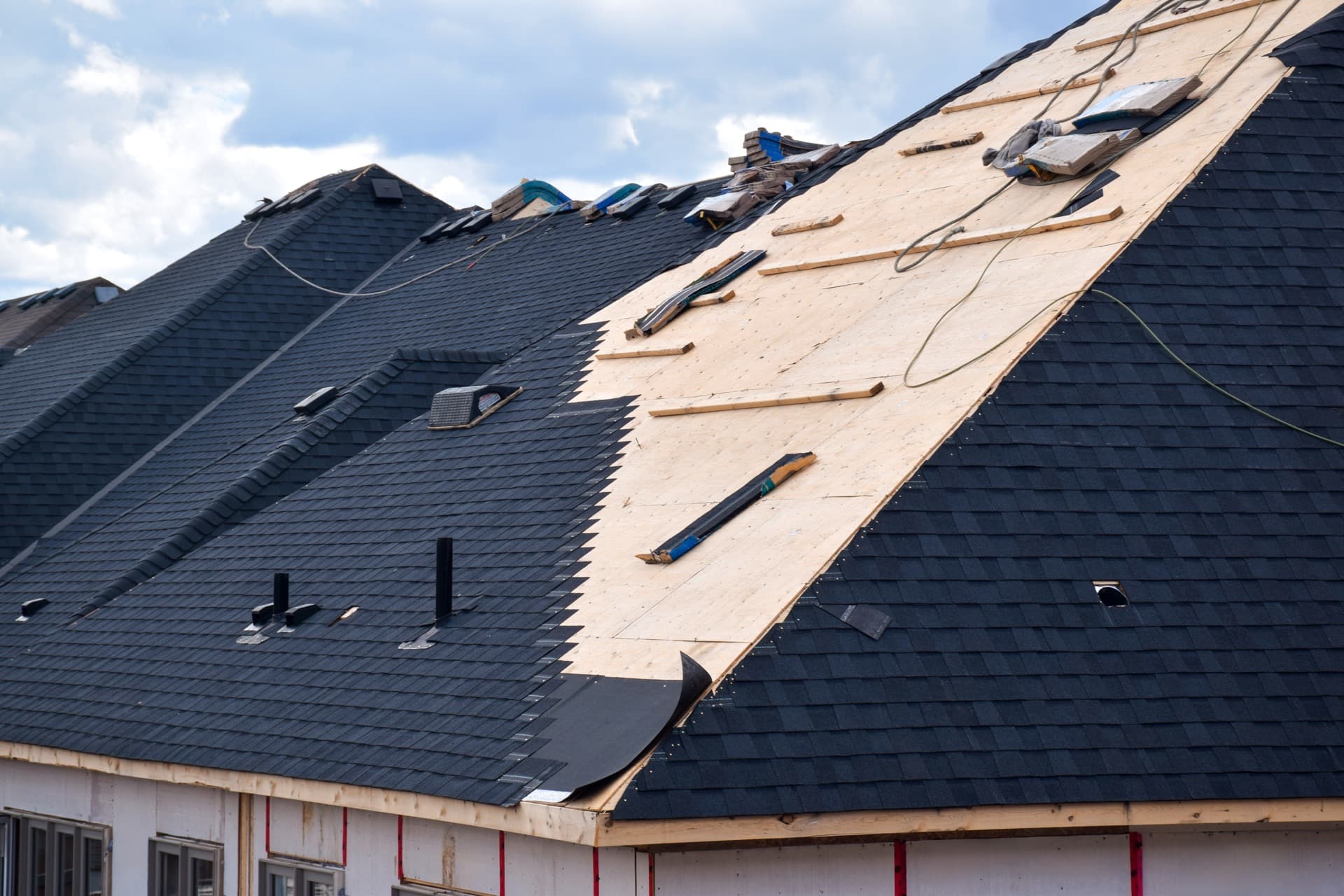
Almost every homeowner we quote asks some version of this question. They've seen the 3-tab option come in $2,000 cheaper and want to know if it's a real downgrade or just a way for roofers to pad the estimate. Here's the straight answer: for almost every single-family home in Seattle right now, architectural shingles are the right call. 3-tab still has a place — just a much smaller one than it used to.
What each one actually is
3-tab shingles are flat, single-layer asphalt rectangles with two cutouts that make them look like three tiles across. They're the old-school shingle most of us grew up seeing on 1980s and 1990s tract homes. Lightweight, uniform, and thin. Architectural shingles (also called dimensional or laminate) are built from two layers of asphalt bonded together, with the tab pattern staggered so the finished roof has depth and texture. They're noticeably thicker, heavier, and they cast actual shadow lines across the slope. Walk through Queen Anne or Magnolia and most of the newer re-roofs you're looking at are architectural.
Head-to-head comparison
| Factor | 3-Tab | Architectural |
|---|---|---|
| Installed cost (per sq ft) | $5.50–$7.00 | $7.00–$9.00 |
| Wind rating | ~60 mph | 110–130 mph |
| Warranty | 25-yr limited | 30–50-yr limited |
| PNW lifespan | 15–20 years | 25–30 years |
| Appearance | Flat, uniform — reads as budget from the street | Shadow lines, real depth and dimension |
| Granule loss rate | Faster — thinner base loses granules earlier | Slower — thicker layered construction holds up |
Wind rating — this one matters in Seattle
November through February, we get wind events in the Puget Sound that routinely push past 50 mph and occasionally hit 70 or 80 in exposed areas. Anyone who was here for the 2006 Hanukkah Eve storm knows what that looked like. On a 3-tab roof, you start losing tabs. On a well-nailed architectural install, the roof is fine. We've handled dozens of post-storm calls over the years, and the pattern is consistent: the cheap shingles come off first.
When 3-tab still makes sense
A few real situations where 3-tab is the right call
Rental properties where you're optimizing for cost per year — if you own a duplex in White Center and need a functional roof for the next 15 years before selling, 3-tab does the job. Very tight budgets where the alternative is no roof at all — a working roof beats a leaking roof every time. Very small structures like a detached garage where the shingle choice barely moves the total cost. Matching an existing 3-tab roof on a partial replacement. Outside of those, go architectural.
The mistake we see most often
The $3,000 savings that costs $15,000
Homeowner gets three quotes. The cheapest uses 3-tab and comes in $3,000 lower. They take it. Twelve years later the roof is already showing wear that a better shingle wouldn't have. They're facing another full replacement a decade early. That $3,000 savings turned into a $15,000 early re-roof. We see this constantly, and it's the number one avoidable mistake in this category.
Brands you'll see in quotes
In Seattle, the three main manufacturers are GAF, CertainTeed, and Owens Corning. All make both 3-tab and architectural lines, and all perform well here. GAF Timberline HDZ is probably the most-installed architectural shingle in our market — 130 mph wind rating with the right nail pattern, solid warranty, reliable middle-of-the-road choice. CertainTeed Landmark is the direct competitor with a slightly different look and similar performance. Owens Corning Duration uses a patented nail zone (SureNail) that makes installs slightly more forgiving on steep or complex rooflines. All three are good — what matters more is the installer. A bad install fails regardless of what brand is on the box.
For a full picture on costs, see our 2026 Seattle roof replacement cost guide. If you want to compare shingles against metal, our metal vs. shingles breakdown covers that trade-off. Ready for a firm number? Contact us for a free written estimate.